
AI weekly plan
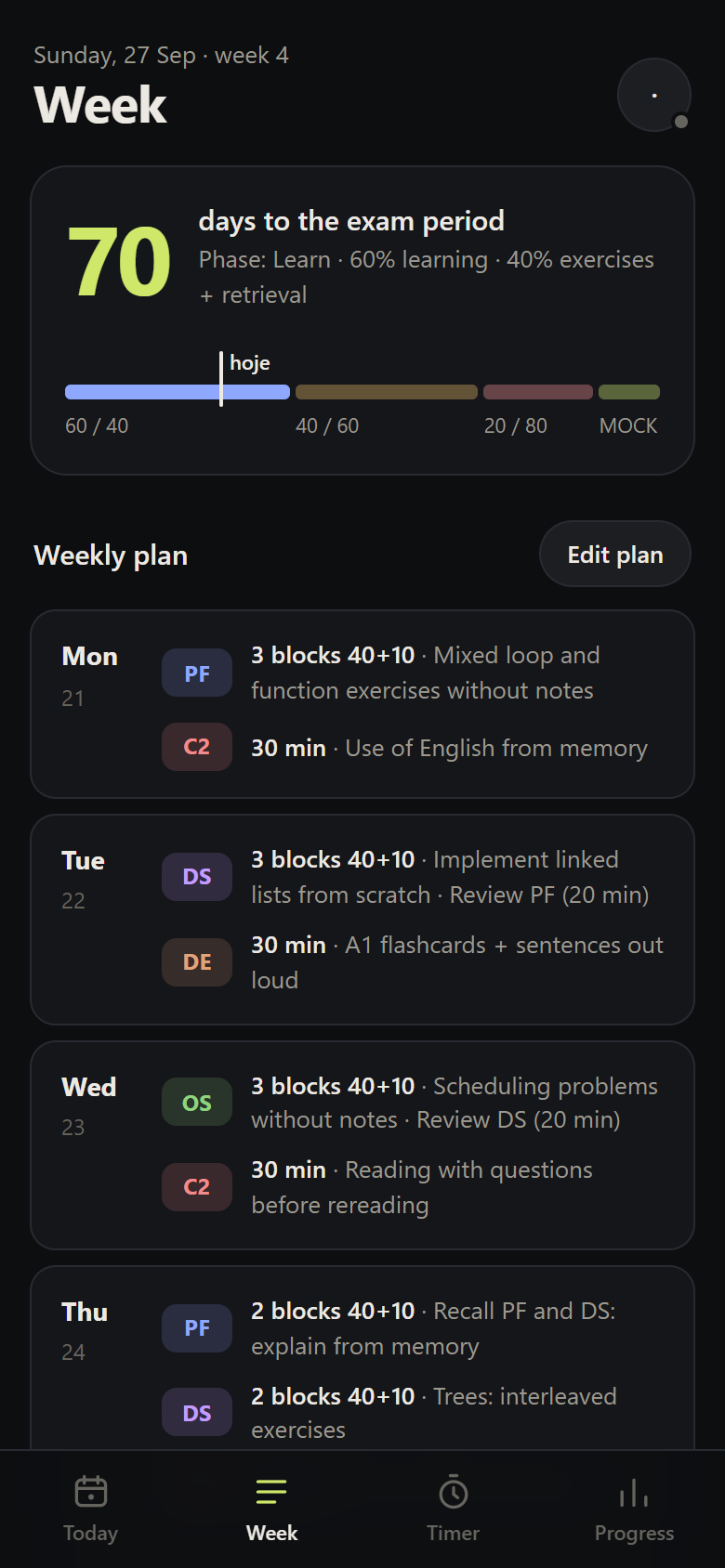
The plan is your typical week: for each day, the sessions — subject, duration and a concrete activity. You can create it by hand, start from the example, or generate it with AI.
What the AI receives
- Subjects: name, code, type, load, ECTS (European credits, a measure of workload), exam date.
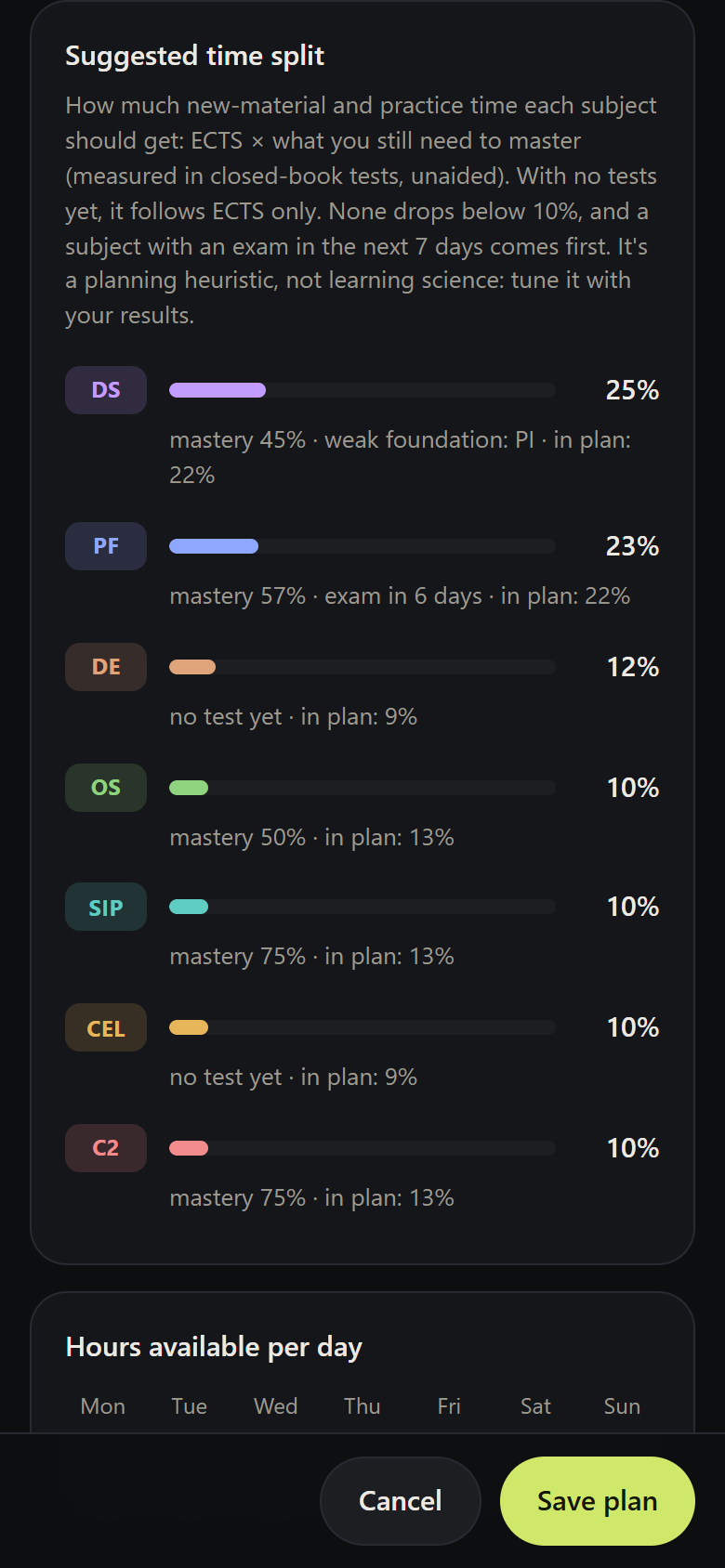
- The suggested share of time and measured mastery of each one (see time allocation).
- Weak foundation: prerequisites not yet taken, failed, or passed with a low grade.
- Start and exam dates, hours available per day and your notes.
The rules it must follow
The system prompt requires the AI to apply:
- Retrieval practice in every session — exercises, questions without notes, explaining from memory. Never rereading, highlighting or summarising as the main activity.
- Spacing — medium and heavy subjects on at least 2 non-consecutive days, with short reviews 1–3 days later.
- Interleaving — mixed exercises; a main session plus a review of another subject on the same day.
- One weekly cumulative retrieval session.
- Blocks with breaks, never exceeding each day's hours.
- Sleep and load — if the hours aren't enough, cut light subjects and languages first, never the spacing of the heavy ones.
- Languages in short, frequent sessions.
- Time allocation according to the suggested share; the nearest exam takes priority.
- Weak foundation → short retrieval sessions on the prerequisite in the first few weeks.
- First exposure in blocks; then mixed practice.
- Phases up to the exam, ending with mock exams under exam conditions.
The response is structured JSON (with a schema), cleaned and validated before it appears: days 0–6, only subjects that exist, dates in the right format.
Scientific check
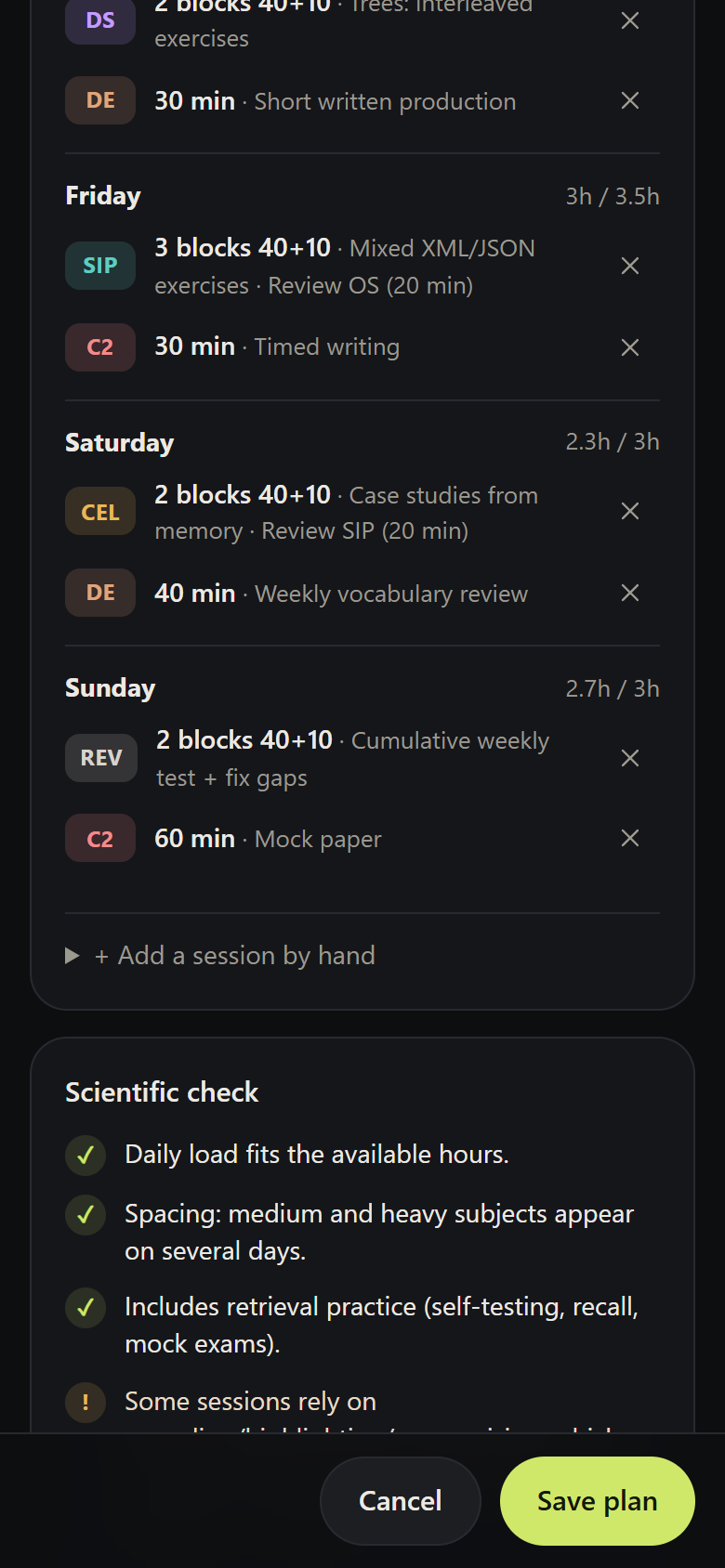
Even so, the AI can make mistakes. The editor runs fixed rules on any plan:
| Rule | Warns when |
|---|---|
| Load | A day goes more than 15% over the available hours |
| Coverage | A subject has no sessions |
| Spacing | A medium or heavy subject appears on only one day (reviews tagged with its code count) |
| Retrieval | There is no test, recall, mock exam or cumulative review session |
| Passive techniques | There are sessions based on rereading, highlighting or summarising |
| Languages | Fewer than 3 sessions a week |
Time allocation
A heuristic, not learning science
There is no evidence linking time per subject to ECTS. This rule decides how much time; the principles decide how. The parameters are adjustable and should be checked against your closed-book tests.
priority(s) = ECTS(s) × deficit(s) × [2 if exam in the next 7 days] × [1.25 if weak foundation]
deficit(s)  = 1 − mastery(s)          — from unaided tests only; with no test, 1
              + 0.2 if overconfident
share(s) = max(10%, priority / Σ priorities), renormalised- Before the first test, the split is proportional to ECTS (without ECTS, it uses the load).
- No subject drops below 10% — spacing never lets it go forgotten for weeks.
- Subjects whose exam is already done leave the allocation.
Providers
AI_PROVIDER | How it's called |
|---|---|
gemini | REST generateContent with responseSchema |
anthropic | Official @anthropic-ai/sdk SDK, structured output (output_config.format) and a server-side fallback if the model refuses |
openai | chat/completions with response_format: json_schema — works with OpenAI, OpenRouter, Groq and others |