Day to day
The method comes down to four habits. The app is designed so that each one is a single tap.
1. Start with the next session
The Today tab shows Up next — the first session of the day not yet done — with the concrete activity ("Mixed loop exercises without looking anything up"). Start focus picks the subject, starts the timer and opens focus mode.
Alerts appear above it when needed:
| Alert | When |
|---|---|
| 🟥 Tomorrow: X exam | The day before — today only retrieval and review, no new material, and a good night's sleep |
| 🟨 X: exam in N days | Final week — that subject jumps to the front; shortcut to a closed-book test |
| 🟥 X: failed in the regular period | The resit date is missing from the degree record |
2. Attempt before you see the answer
During the block, work from memory: solve, answer, explain — and only then check. On paper, if the exam is on paper.
At the end of the block (5 minutes or more), the app asks:
- What did you do? — New material (first exposure: it counts, but not towards mastery) or Exercises / retrieval.
- How many did you attempt? — a blank exercise counts as attempted and wrong.
- How sure are you? (1–4) — before you mark.
- Did you use AI, notes or worked examples?
- Confirm and go mark — your confidence is locked. Only now do you enter how many you got right.
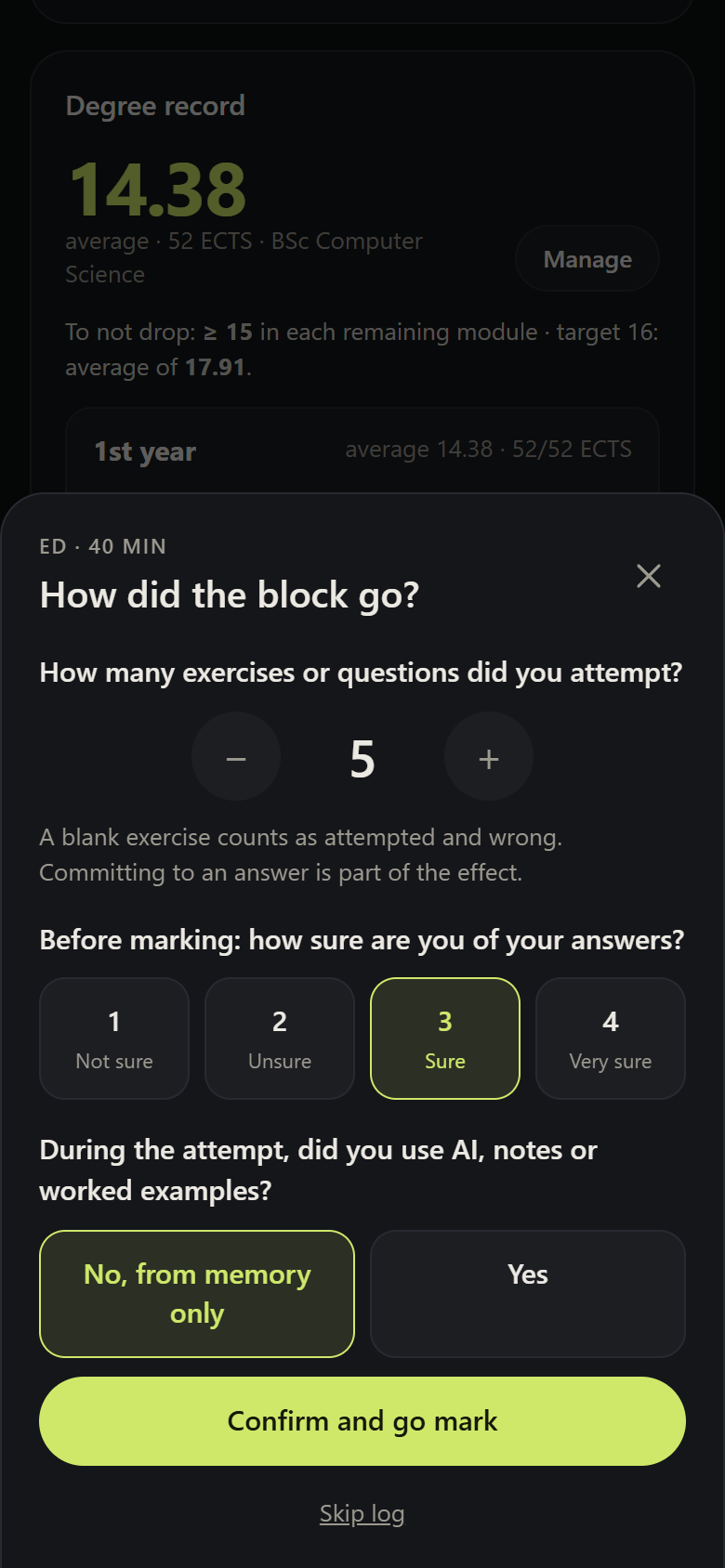
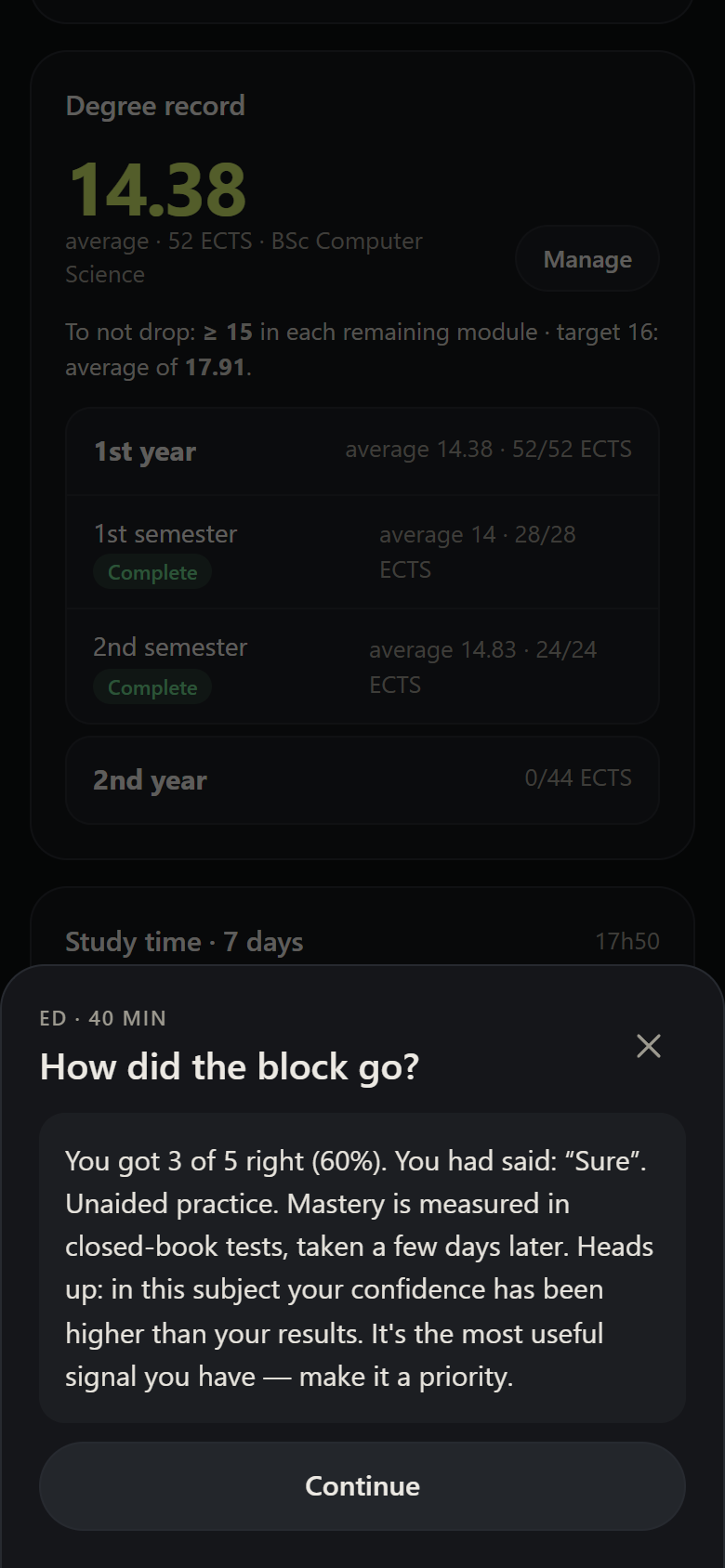
The order is the point: a confidence rating given after seeing the answers measures nothing. See Block log.
3. One closed-book test per week, per subject
In Progress → Closed-book test: you choose the subject and the time (15–45 min) and do, on paper and without notes, exercises you have not solved in the last 7 days, mixing topics. It's the only source of your mastery.
- No past exams? Keep a few exercises from each problem sheet just for this.
- Starting from zero? That's normal — the test only covers the material you've already studied.
4. Read Progress in the right order
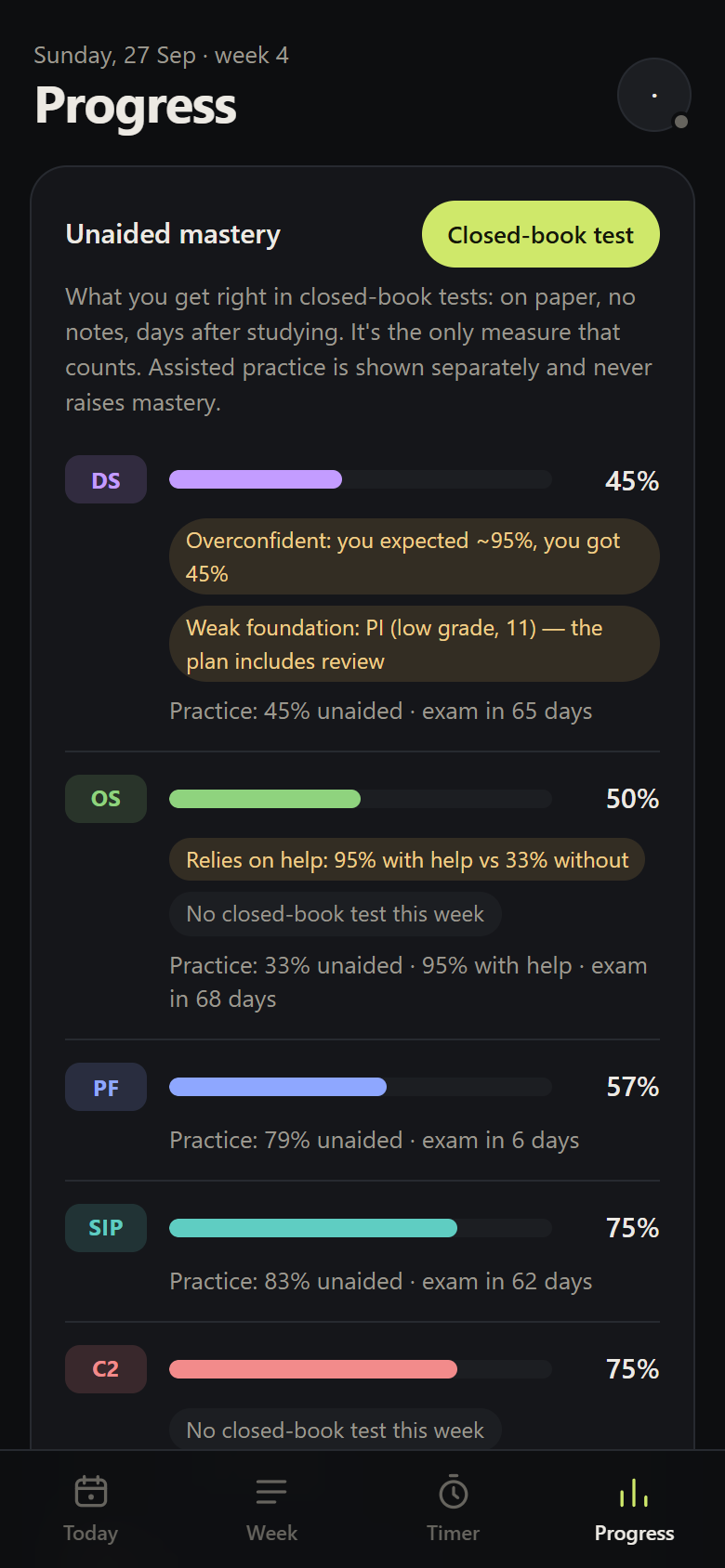
Progress sorts subjects like this:
- Overconfidence — you expected to get more right than you did. It's the most useful signal you have.
- Lowest measured mastery.
- No test yet, by nearest exam date.
It also flags relies on help (much better with help than unaided, and help used most of the time) and weak foundation (a prerequisite not yet taken, failed or graded below 12 out of 20).
What about time?
It's there — minutes per day and per subject, day streaks — but in the background. Time is what you put in; mastery is what you learn. The app won't let you confuse the two.